Discover Your Potential. Shape the Future, Together.

Your journey starts in the brain
At STX Group, we believe progress starts with people. Our mission to accelerate the global transition to a low-carbon economy depends on the strength of our collective talent — diverse thinkers, bold collaborators, and purpose-driven individuals with unique perspectives.
That’s why we’ve partnered with BrainsFirst. We're committed to science-based hiring, and BrainsFirst provides a robust, scientifically validated approach to understanding cognitive strengths. We believe everyone is an 8 or a 9 in something — the real question is: in what? Your brain is the starting point. Not your CV, not your diploma, but how your brain is wired at its core. This allows us to move beyond traditional assessments and truly understand your inherent potential.

Step

Your Brain Profile

Through your Brain Profile, you’ll gain a deeper understanding of your natural cognitive strengths. It’s not just about fitting in — it’s about discovering where you thrive, how you collaborate best, and how you can make smarter choices for your growth and your future.
Step

Best Fit

This is where your unique brain meets the perfect role. We use this Brain Profile to better align your talent with the specific cognitive demands of a role. This process helps ensure a great fit, contributing to both your performance and retention. It allows us to accelerate your transition to long-term success.
Step

Cognitive Diversity

This partnership is also a key component of our commitment to supporting Diversity, Inclusion, and Belonging (DIB). By focusing on fundamental cognitive abilities rather than solely on past experiences or academic credentials, BrainsFirst helps us mitigate unconscious biases, ensuring we discover a wider range of talent.
At STX, you’ll be surrounded by people who challenge and support you. We learn from each other, we grow together, and we move fast - because the world won’t wait. Whether you're joining through our traineeship or stepping into a specialist role, your journey here is about unlocking potential — yours and ours.
Let this be the start of something meaningful. For your career. For the planet. For progress.
Your Cognitive Process
To help you understand your inherent potential and how we measure it, let's explore the core cognitive processes revealed by the NeurOlympics.
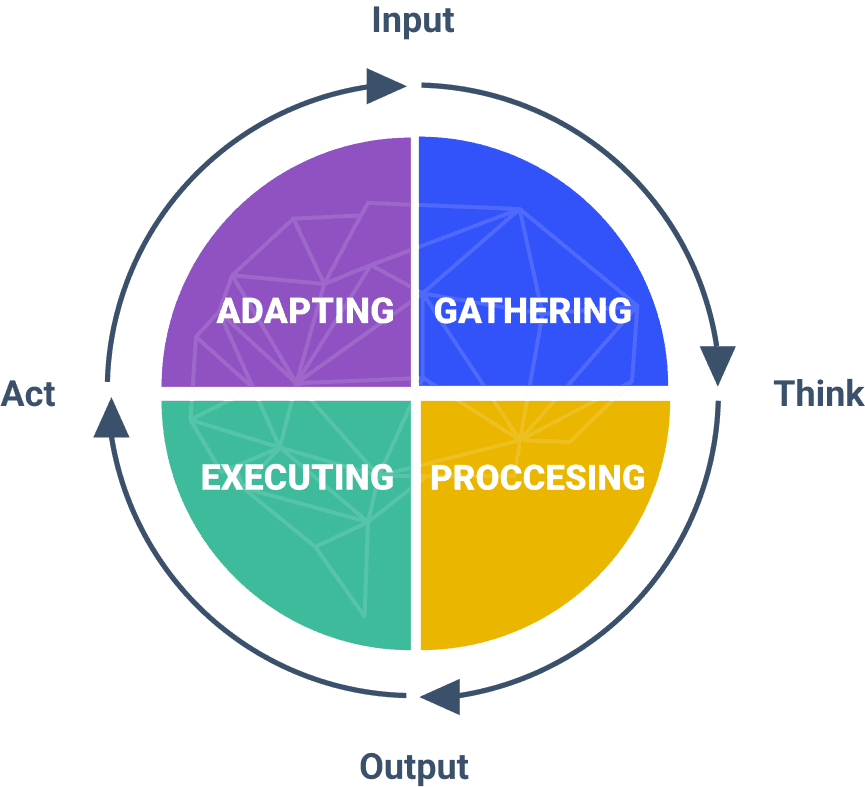
The games measure 16 cognitive skills that make up your brain's executive functions. Did you know that these 16 cognitive skills can be divided into four phases? Understanding how these skills are categorized and interact helps you grasp the bigger picture and what your results mean for your behavior in specific contexts, such as the workplace.

Step

Gathering

The first phase is Gathering which shows how we perceive, select and - consciously or unconsciously- ignore information. The cognitive skills belonging to this phase are concentrating, blocking, dividing, and anticipating. These skills determine how you handle input.
Step

Processing

The second phase is Processing which shows how we process and use relevant information. The cognitive skills belonging to this phase are capacity, eye for detail, processing speed, and prioritizing.These skills define your way of processing information and thus your way of thinking.
Step

Executing

The third phase is Executing which shows how we act based on processed information. The cognitive skills belonging to this phase are consistency, action speed, precision, and grit. These skills determine the way you act.
Step

Adapting

The fourth phase is Adapting which shows how we monitor and adjust on outcomes of our actions. The cognitive skills belonging to this phase are self-control, switching, directing, and letting go. These skills determine how you adapt to new or changing information.
With any task that you complete, you gather and process some kind of information and execute and adapt in a certain way. Your brain moves through these essential phases to help you achieve the desired outcome.
Understanding Cognitive Patterns
Memory overload?

Memory overload?

When it comes to processing a lot of information, it comes down to your capacity, eye for detail, and prioritizing skills. Scoring high on capacity and eye for detail, means that you can process a lot of information at the same time, so you might be less sensitive to memory overload compared to someone scoring low on capacity and eye for detail. If you score high on prioritizing however, you can quickly differentiate between relevant and irrelevant information, which can protect you from memory overload nonetheless.

Do natural multitaskers exist?

Do natural multitaskers exist?

When it comes to productivity, we all know that multitasking isn't ideal – monotasking is generally more effective. However, there are some people for whom multitasking is less detrimental than others. This often comes down to your dividing and switching skills. If you score high on both, you're quite good at dividing your attention across multiple tasks and you lose minimal efficiency when switching from one to another. So yes, compared to others, you can call yourself a natural multitasker.

Are you distracted by the outside or the inside?

Are you distracted by the outside or the inside?

Are you easily pulled away from your task by what's happening around you, or do your own thoughts tend to interrupt your focus?
The way you handle distractions depends on the balance between your concentration and blocking skills. If both are strong, you’ll find it easy to tune out both external noise and internal thoughts, making you productive in almost any environment. If you're good at blocking external distractions but have lower concentration, your own thoughts may be the biggest challenge. In that case, a bit of background noise, like music or a busy environment, can actually help by giving your mind something to settle on. On the flip side, if your concentration is high but your blocking is lower, you'll be sensitive to external activity but can focus incredibly well once those outside distractions are minimized, for example by noise canceling headphones.

Low scores? That's by design!
As you dive into your Brain Profile, it is important to understand that you will not score high on everything. Our games are designed to challenge you and push you to make strategic trade-offs, for which there is no right or wrong. For example, in game 3 and 4, you are pushed to trade off accuracy and speed. Because of this, it is normal to score high on some skills and low on others. In fact, for certain contexts and roles, scoring low on specific skills can be incredibly beneficial.

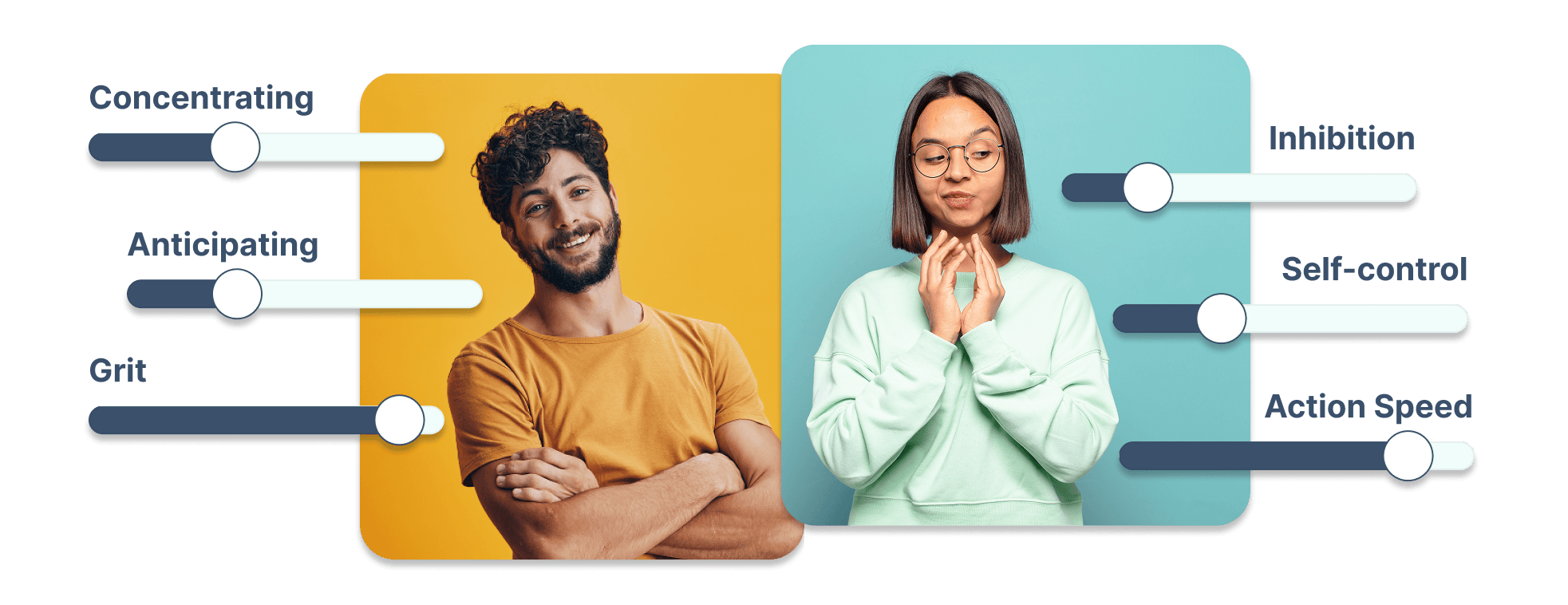
As a trader for example, a lower score in inhibition or self-control can actually be an advantage, as this enables more risk-taking behavior needed for that role. A teacher might benefit from a lower score on concentrating. This allows them to stay open and perceptive to everything happening around them in a dynamic classroom. A lawyer would rather score low on speed, as mistakes are quite costly and impactful in their profession. And in a team setting, scoring low on grit can help you to ask for help earlier on in the process instead of struggling alone.
As you see, every skill has its unique advantages and disadvantages depending on the situation. So, remember, scoring low on something is not necessarily bad. It is all about understanding your personal strengths and weaknesses, and finding the context which suits your specific brain best. Understanding these individual strengths and trade-offs is key to how we effectively match you with the right opportunities.

Sometimes, you might not fully recognize yourself in the results, and that's okay! This happens for about 10% of participants. We use models to map cognitive abilities, and while these models are based on solid research, they might not perfectly align with every individual brain. Traditional assessments, like personality questionnaires, often rely on your own self-evaluation, but research shows people aren't always accurate when assessing themselves. The NeurOlympics, on the other hand, objectively measure how your brain functions, and this objective measurement might sometimes differ from how you perceive yourself. We only recommend replaying the games if the conditions weren't ideal when you first played, as your results are typically very consistent under similar conditions.
Your Journey to Success
Matching Job & Brain

Matching Job & Brain

These nuanced insights into your brain's unique wiring are what allow us to create impactful career connections. Finding the right fit between your unique cognitive strengths and a specific role is crucial. For each role, a Goal Profile can be created, this essentially outlines the unique combination of cognitive abilities and required behaviors needed to succeed and thrive in that particular job. By matching your individual Brain Profile – which objectively shows how your brain functions – with the Goal Profile for a role, we can identify a great fit and help you find where your natural strengths shine brightest.

The Trainee Program & Your Brain Profile

The Trainee Program & Your Brain Profile

We apply this same precise matchmaking approach in the selection process for our Trainee Program. Our aim is to find individuals who are a natural fit for the dynamic challenges and diverse experiences the program offers. We achieve this by creating a specific Goal Profile for the Trainee Program itself. This profile defines the core cognitive abilities and behavioral traits that enable trainees to truly thrive, adapt, and grow within the program and at STX Group.

The Science Behind
Our commitment to objective and fair assessments, and the valuable insights they provide, are all backed by robust scientific principles.
Learn more about the science behind NeurOlympics below. Do you have a question about another topic?

Take a look at the Frequently Asked Questions!
Go to FAQs
Quality of the NeurOlympics

Quality of the NeurOlympics

At BrainsFirst, we prioritize the quality and reliability of the NeurOlympics to provide you with an accurate assessment and enable a genuine job-brain match. We adhere to the highest standards of science and follow the guidelines set by the Dutch organization responsible for testing quality (COTAN). This commitment to quality is achieved through four key criteria.

Test Hygiene & Reliability

Step

Criterion Validity

We strive for the games to be directly connected to real-world data. Your performance on the NeurOlympics should correspond to your actual performance in the workplace. This alignment guarantees that hiring decisions based on the assessment contribute to the desired efficiency of employees.
Step

Construct Validity

To accurately measure the executive functions, such as attention and working memory, we ensure that the games have a strong connection to the constructs they claim to assess. This scientific validity ensures that decisions made based on the game results are objective and aligned with the way the brain functions.
Step

Concurrent Validity

While the NeurOlympics provide a unique talent assessment approach, they are designed to relate to other tests that measure similar outcomes, such as IQ tests. This connection validates that different measures of brain functioning align with each other, enhancing the overall validity of the assessment. However, it’s important to note that maintaining test hygiene is crucial, particularly regarding concurrent validity and reliability.
Step

Reliability

To ensure consistency and accuracy, it is crucial that the NeurOlympics yield similar results with each administration. This ensures that the outcomes truly reflect your brain’s functioning, allowing for informed hiring decisions.
What is Test Hygiene?

What is Test Hygiene?

Have you noticed different results when taking the NeurOlympics on separate occasions? Test hygiene likely played a role in those variations. Test hygiene refers to how the test, in this case, the NeurOlympics, is conducted. It encompasses factors like your effort, performance, following instructions, as well as external factors such as the test environment and the time of day you take the assessment. Test hygiene directly impacts your performance. Therefore, if you take the NeurOlympics multiple times and there are differences in test hygiene, the game results may differ. To ensure accurate assessments that reflect your abilities to the fullest, it’s crucial to maintain proper test hygiene. The easiest way to do so is by taking the games during your brain’s peak, ideally around 11 in the morning, in a quiet environment.

Testimonials

What Others Say


blocks
blocks
carousel-image
Marijn van DiessenCEO at STX

We believe our people are our most valuable asset, and our dedication to hiring top talent reflects our drive to remain at the forefront of the industry.

blocks
blocks
carousel-image
Megan CowellTalent Acquisition Specialist at STX

As a recruiter, BrainsFirst has truly changed the way I assess talent. It allows me to look beyond the CV and gain objective insights into candidate’s cognitive skills - often uncovering potential that traditional methods would miss. It’s become a key part of making our hiring more inclusive and data-driven.

Demo layers
Questions and Support

If you have questions about recruitment, please feel free to contact STX at recruitment@stxgroup.com. For technical support regarding NeurOlympics, you can reach out to support@brainsfirst.com.